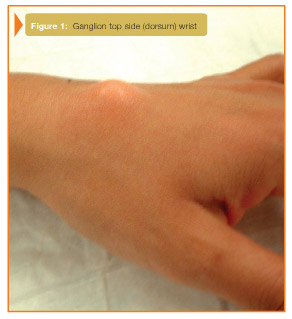
My apologies for being MIA. As some of you may know, I got into a bit of a situation exactly one month ago involving a traumatic injury to my wrest. Unfortunately, that required me to take medical leave...so surgery was left in the middle. I'll be completing it later this year. BUT, I did get to see quite a bit of surgeries before I took time off. Because my injury is focused in the region of the hand and wrist, I'll be describing one of the surgeries I witnessed before taking leave: a ganglionectomy.
To start off, lets review some anatomy. See the pic below to avoid confusion. Starting off with the bones of the forearm: ulna (close to the pinky) and radius (on the side of the thumb). The bones of the hand are a bit difficult to remember, but I think of it as three different sections - the base being composed of the carpals, metacarpals make up the palm, and phalanges make up the fingers. Take a look at the pictures(http://www.graphicshunt.com/health/images/hand_bones-1318.htm) for a visual understanding. Now lets talk about the meat, haha, by that I mean muscles. Since they're a bit difficult to put out in words, lets just stick to the pictures. Lets move onto the topic of the day.

Ganglion cyst. What is that? Well...........here is the 411 on this medical condition.
What: fluid-filled swellings around the tendons and joints
Where: usually in hands and feet but can be located near any joint
Why (aka Cause): definitive cause is unknown, however studies suggest trauma to the joint or an anatomical anomaly in joint capsule or tendon sheath [creating a one-way valve that allows joint fluid out of joint but not back in] could be possible causes.
Symptoms: most cysts are raised, round lumps that can vary in size. Usually asymptomatic, hardly painful. However, the cysts can cause pressure on nearby nerves creating pain/weakness/numbness
Tests & Diagnosis: Physical exam, X-ray (to rule out other conditions), Aspiration (to confirm diagnosis by drawing out fluid in cyst), other Imaging tests (MRI, ultrasound for location, size, shape and depth)
Treatment: if ganglion cysts are painless, no further treatment is required. Its a watch and wait sorta thing. However, once the cyst becomes painful and starts interfering with one's daily activity, then can you think about some treatment options.
- immobilize - to prevent further growth of the cyst and possible shrinkage. By limiting movement, pressure on nerves can be relieved.
- aspirate - drain fluid from cyst with steroid injection following to prevent inflammation. With this treatment, the recurrence rate can be up to 60%
- Surgery - Ganglionectomy - outpatient procedure involving the excision of ganglion cyst usually under local anesthetic, perhaps even general reserved for cases with chronic pain
Ganglionectomy - my experience:
Probably the quickest procedure I saw in the 20 or so days of surgery, we were literally in and out of the OR. I think scrubbing in took longer than the actual removal of the cyst.
Initially, the patient is given general, regional, or local anesthetic to relax muscles and fall asleep. In this case, it was the removal of a large ganglion cyst of the dorsal wrist, so the patient was given general. The procedure was done by a plastic surgeon who made the incision right through the center, complete length of the round cyst; just after palpating the borders. She then separated out the extensor tendons and found the ganglion cyst in close proximity to the radial nerve. The difficult portion was excising the base of the ganglion cyst which was almost attached to the radial nerve. It was key that we get the stalk of it, because the recurrence rates can be quite high. So, once the cyst was out we got to feel it! It felt like a squishy but somewhat firm ball of white goo. Afterwards, stitches were put in and patient was wheeled out. Quick, somewhat easy and simple. Here are a few pictures! Enjoy :)